Wir durchsuchen 2.083.464 Objekte für Sie.



Enchère: 6 Jours
Prix actuel 18.05.2026
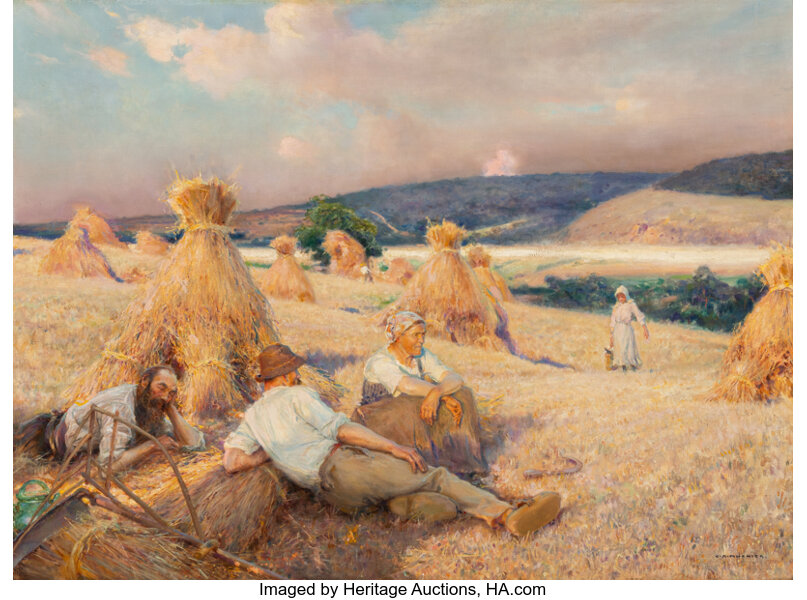
Jules Alexis Muenier (French, 1863-1942) Le repos des moissonneurs (The harvesters' rest), 1907 Oil on canvas 36 x 48 inches (91.4 x 121.9 cm) Signed and dated lower right: J. A . Muenier / 1907 Property from a Private Florida Collection PROVENANCE: The W.P. Wilstach Collection, Fairmount Park, Philadelphia, 1917; Philadelphia Museum of Art, transferred from the above, deaccessioned in 1947; Parke-Bernet Galleries, New York, February, 1947; Private collection, United States; Christie's, New York, March 1, 1984, lot 91; Pyms Gallery, London; Private collection, acquired from the above 1984; Sotheby's, London, May 25, 2016; Acquired from the above. EXHIBITED: Salon, Paris, 1907, no. 914; [Probably] Exposition universelle et internationale de Bruxelles, Brussels, 1910, no. 239; Pyms Gallery, London, "Rural and Urban Images: An Exhibition of British and French Paintings 1870-1920," 1984, no. 26. LITERATURE: Société Nationale des Beaux-Arts, L'Art et les artistes, vol. IV, 1907, p. 81; Catalogue of the W.P. Wilstach Collection, Philadelphia, 1922, p. 85, no. 219, as Harvesters at Rest; Itinéraires champêtres - Jules Alexis Muenier (1863-1942), peintre sous la IIIe République, exh. cat., Vesoul, 2002, pp. 6, 16. Jules-Alexis Muenier's Le repos des moissonneurs, exhibited at the Paris Salon of 1907, represents a mature synthesis of the artist's Naturalist training. A leading figure in the popularization of rustic Naturalism, Muenier devoted much of his career to scenes of rural life in his native Franche-Comté, drawing on the daily rhythms of agricultural labor in and around the village of Coulevon. His practice, shaped by his academic training under Jean-Léon Gérôme and his close association with Pascal-Adolphe-Jean Dagnan-Bouveret, was marked by a commitment to accuracy, often achieved with photography as a preparatory tool, which allowed him to construct compositions of remarkable clarity and immediacy. In Le repos des moissonneurs, Muenier turns to a familiar Naturalist theme: the pause from labor. Here, a group of field workers recline amid freshly cut sheaves, taking respite from the heat of the day, while a young woman approaches from across the field bearing provisions. The composition recalls earlier treatments of rural labor by artists such as Jean-François Millet and Léon-Augustin Lhermitte (see lot 69122), yet Muenier adopts a brighter and more varied palette. Without sacrificing the precision of his figure drawing, he incorporates light mauves and purples within the shadows while rich greens are scattered throughout the landscape, suggesting an acknowledgment of Impressionism and enriching the painting's plein-air effects (Rural and Urban Images: An Exhibition of British and French Paintings 1870-1920, exh, cat., London, 1984, p. 68). The figures themselves are powerfully modeled, embodying both the physicality and quiet dignity of rural life. The expansive landscape—punctuated by haystacks and suffused with warm, atmospheric light—connects the fieldworkers to the land, allowing the work to function as a broader meditation on labor, rest, and the rhythms of rural life. Painted at a moment when Naturalism was embraced by gallerists, collectors, and the public, Muenier's work exemplifies the movement's appeal: images rooted in observation, rendered with technical precision, yet animated by a sensitivity to light, color, and lived experience. The balance between tradition and innovation illustrated by Le repos des moissonneurs made it an ideal acquisition for the W. P. Wilstach Collection. The W. P. Wilstach Collection originated with Philadelphia merchant William Platt Wilstach, who envisioned a public art collection for the city but died in 1873 before fully realizing the project. His widow, Anna H. Wilstach, continued to build the collection through significant acquisitions in Europe and, in 1892–93, bequeathed it to the City of Philadelphia along with a substantial endowment, stipulating that it remain freely accessible to the public. The collection was initially installed in Memorial Hall and administered by the Commissioners of Fairmount Park. In 1917, the year the present work entered the collection (joining Muenier's The Entrance to the Village acquired in 1902), custodianship was transferred to the Philadelphia Museum of Art, where it became a foundational part of the museum's holdings. Its endowment—known as the Wilstach Fund—continues to support acquisitions and to shape the institution's mission as a public, educational, and accessible museum. HID12401132022 © 2026 Heritage Auctions | All Rights Reserved www.HA.com/TexasAuctioneerLicenseNotice
Salon de la Société Nationale des Beaux-Arts, Paris, 1907, no. 914; [Probably] Exposition universelle et internationale de Bruxelles, Brussels, 1910, no. 239; Pyms Gallery, London, "Rural and Urban Images: An Exhibition of British and French Paintings 1870-1920," 1984, no. 26.
The W.P. Wilstach Collection, Fairmount Park, Philadelphia, 1917; Philadelphia Museum of Art; Parke-Bernet Galleries, New York, February, 1947; Private collection, United States; Christie's, New York, March 1, 1984, lot 91; Pyms Gallery, London; Private collection, acquired from the above 1984; Sotheby's, London, May 25, 2016; Acquired from the above.
Stretcher bar line creases along upper edge of canvas.
Under UV: varnish fluoresces green. Scattered small dashes or retouching in sky, with larger spot towards upper right.
Framed Dimensions 45 X 57 Inches