Wir durchsuchen 2.068.950 Objekte für Sie.



Enchère: 18 Jours
Prix actuel 18.05.2026
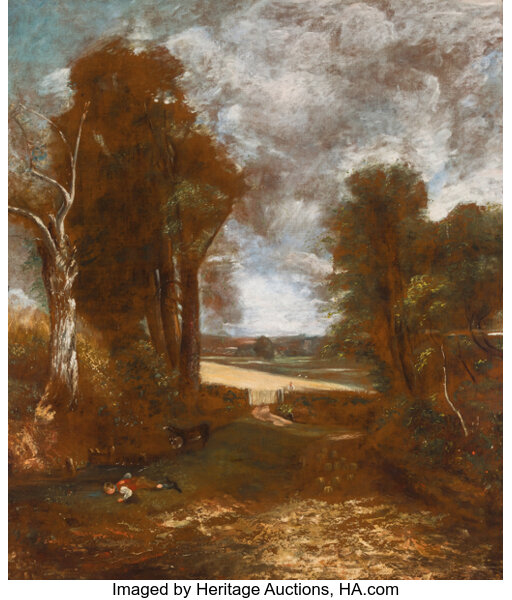
John Constable (British, 1776-1837) The Cornfield (full-scale study), circa 1820-6 Oil on canvas 55-1/2 x 47-1/2 inches (141.0 x 120.7 cm) Property from the Jefferson Historical Society and Museum to benefit the Development Fund PROVENANCE: [Possibly] Foster and Sons, London, May 16, 1838, part of lot 14 ("The Corn Field; a study from nature, for the picture in the National Gallery), to Radford; Newhouse Galleries, New York; Collection of the Jefferson Historical Society and Museum, Jefferson, Texas, gift of the above in 1970. This monumental full-size sketch by John Constable for one of his most celebrated paintings, The Cornfield of 1826 in the National Gallery, London, represents a major art historical discovery. For the past fifty years, the work has been on virtually continuous display at the Jefferson Historical Society and Museum in Jefferson, Texas, a small river town in the far eastern part of the state—visible in plain sight but, owing to its location, unknown to Constable scholars. Its emergence on a wider stage is celebrated as a key artistic event this year, coinciding with the 250th anniversary of the artist's birth. Although it is well known that Constable made full-scale sketches in oil for most of the large pictures he exhibited at the Royal Academy from 1819 onwards, it has long been assumed that he never made one for The Cornfield, the first work by the artist to have been acquired for the British National Collections following his death in 1837. The survival of its full-scale sketch therefore represents a significant addition to the small and distinguished group of the artist's largest preparatory oils where his thought processes are on full display (C. Rhyne, "Constable's First Two Six-Foot Landscapes," Studies in the History of Art, vol. 24, National Gallery of Art, Washington, 1990, pp. 109-26 for a list of twelve full-scale sketches). The role of these full-scale sketches can best be understood in relation to the shift in Constable's practice after his move to London following his marriage to Maria Bicknell in 1816. During his earlier career, he had been deeply committed to painting the scenery of his native Suffolk, in East Anglia, near the village of East Bergholt, where he had been born and raised. He often worked directly from nature, whether making sketches or, for a time, attempting to complete pictures largely on the spot. After 1816, however, although his attachment to Suffolk remained a powerful impetus, his methodology changed. From 1818-9 he began producing large-scale exhibition paintings of around six feet in width, known as his "six-footers": works designed to command attention on the crowded walls of the Royal Academy and to help him achieve his longstanding ambition of election as an Associate Royal Academician, while also making sales to support his growing family. To realize these ambitious canvases in the studio, away from the motif, Constable depended on earlier material made directly from life but also developed the highly unusual practice of painting full-scale preparatory sketches in oil. These full-size studies allowed him to establish, at scale, the distribution of light and shade and to experiment with the placement of landscape features and figures before executing the final picture. In this way, he hoped to make fewer changes on the exhibition canvas, preserving a freshness of surface that remains one of the prized and defining qualities of his mature work. Indeed, these preliminary sketches possess a freedom of gesture, immediacy, and bravura that art lovers today have come to prize over the academic polish of his finished works. The evolution of The Cornfield and its full-scale sketch The subject of The Cornfield, unlike the artist's previous scenes on the River Stour, focuses on inland landscape and was clearly inspired by an earlier, unfinished painting, A Cornfield, circa 1817 (Tate Britain). That work depicts a section of Fen Lane, near Constable's hometown and along which he used to walk, as a boy, to and from school in nearby Dedham. The painting, likely made largely on the spot, was never completed, but its latent potential as a subject remained (L. Parris and I. Fleming-Williams, Constable, Tate Britain, London, exh. cat., 1991, cat. 91, pp. 184-5, argue convincingly for a plein-air production). The field of "corn," meaning "wheat" in England, also had an autobiographical association for Constable: his father was a grain merchant and owner of mills on the Stour. In a small studio sketch now in the Indianapolis Museum of Art at Newfields, Constable explored a more structured version of the scene, introducing the motif of a shepherd boy pausing to drink while driving sheep down a lane framed by trees. This idea likely drew both on his own earlier sketches and on pastoral compositions by Claude Lorrain and Gaspard Dughet (A. Lyles, "Nostalgia as nature intended: Tate Britain rehang In Focus II," Tate Etc, issue 28, September 2, 2013). Here, Constable combined careful direct observation with artistic precedent, establishing the essential conception that would ultimately lead to the National Gallery painting. It was at this point, with the small compositional sketches to hand, that he turned to the full-scale sketch. In this large canvas, the composition was significantly reworked and given its full pictorial breadth. The space between the principal trees was widened to admit more sky between them, in the process ignoring even his own spirited underdrawing, which was recently revealed through infrared reflectography (observations by conservator Sarah Cove during IRR conducted in her studio by Kate Stoner, Tager Stoner Richardson Ltd., UK, May 2025). The sheep descending the lane were retained, and new elements were introduced. Among these are the donkey and foal, derived from an earlier Suffolk study (Victoria and Albert Museum), while the drinking boy's jacket was changed from blue to red. Notably, the full-scale sketch marks the first appearance of the half-dead tree at left, adapted from Edge of a Wood of 1815-6 (Art Gallery of Ontario, Toronto). Its marvelously gnarled, silvery trunk, catching the light, creates a striking contrast with the surrounding foliage and reflects Constable's awareness of a favorite compositional device of the seventeenth-century Dutch landscape artist Jacob van Ruisdael, whom he deeply admired. Additional details in the middle and far distance—including figures, harvesters, and a distant church—were established here and carried into the final painting, even where they do not match the actual landscape. Certain features of the finished National Gallery painting are not yet present, including the sheepdog, the plough near the gate, and the elaborate foreground flora. Nevertheless, the full-scale sketch represents the decisive moment at which the composition was fully orchestrated, offering rare insight into Constable's creative process at its most expansive scale. Dating and the question of an earlier origin When working on a new large landscape for the Academy exhibition, Constable would often refer to the developing, or completed, subject in his letters, especially those to his great friend Archdeacon John Fisher. For example, in 1826 he described The Cornfield, the finished version, to Fisher as "a subject ... inland-cornfields - a close lane, kind of thing ... the trees are more than usually studied and the extremities well defined ... as well as their species - they are shaken by a pleasant and healthful breeze - 'at noon'" (R. B. Beckett, ed., John Constable's Correspondence: The Fishers, vol. VI, Ipswich, 1968, p. 216, letter of April 8, 1826). Constable rarely mentioned full-scale sketches in his correspondence, but it is generally assumed that he began them just before, and worked on them alongside, the exhibition paintings. However, the existence of this large-scale study rewrites the accepted chronology and development of The Cornfield. Both technical and documentary evidence point to a more complex genesis. When the painting was carefully studied and technically examined over the past year by conservator Sarah Cove and art historian Anne Lyles, a number of fascinating revelations emerged. One is that the painting is primed with a ruddy brown color that Constable essentially abandoned after circa 1820 in favor of using lighter grounds, usually a stippled off-white or pale pink priming to gain greater luminosity in his skies. The presence of this darker ground therefore establishes a possible first date for when he could have begun the picture (circa 1820), and/or to the reuse of an older, pre-primed canvas retained in the studio. Moreover, technical analysis indicates that the sketch was executed in at least two phases, a fact deduced both from a shift in his style of paint application and the fact that the paint from the first pass had fully set before he continued working on the composition. The existence of an earlier phase strongly suggests that the composition itself had already been established some time before, perhaps months or even years, rather than devised entirely in response to the immediate pressure of the 1826 exhibition. This question of timing is closely bound up with Constable's work on The Opening of Waterloo Bridge (Tate Britian), a subject he had long intended for exhibition at the Royal Academy. He had been engaged with the composition for several years and, by late 1825, was working intensively to bring it to a state suitable for submission to the 1826 exhibition. However, by mid-January 1826 he wrote to John Fisher that the picture was "at a stand," and led him to abandon it (ibid, p. 212, January 14, 1826). With just over two months remaining to produce something for the exhibition, he turned to a replacement subject: The Cornfield. In this context, the possibility that the full-scale sketch had already been started becomes especially compelling. Lyles and Cove both speculate on the basis of Constable's correspondence that he may have begun the painting on commission earlier in the 1820s, then set it aside when he abandoned those projects, only to return to it later and transform it rapidly into a large working study for a picture of profound importance to him—one he executed under enormous time constraints within the first three months of 1826. Provenance and later history Given that Constable never referred explicitly to his full-scale sketches in his correspondence, the first public indication of their existence came with the sale of his studio contents at Foster and Sons, London in May 1838, a year after his death. The catalogue descriptions are brief and give no dimensions, making identification difficult. It is reasonable to suppose that the full-scale sketch for The Cornfield was included in that sale. However, it cannot be securely identified with any specific lot. Of particular interest is lot 14, which lists "The Corn Field; a study from nature, for the picture in the National Gallery." This work has generally been identified with the Indianapolis sketch rather than the present canvas, not least because the latter would be difficult to describe as a "study from nature." Equally notable is the absence of any clear reference to a large-scale sketch corresponding to the National Gallery painting, especially when other full-scale sketches are sometimes identifiable in the catalogue. This raises the possibility that the present work was either not included in the sale or was among additional items not clearly described. The subsequent history of the painting remains obscure. By 1968-70 it had reached Newhouse Galleries in New York. A letter of March 25, 1970, from Clyde Newhouse records the gallery's offer to present the painting to the Jefferson Historical Society and Museum in Texas, describing it as "the large sketch for the painting now in the National Gallery in London," and noting the support of Constable scholar Carlos Peacock (letter preserved in the files of the Jefferson Museum). Today, The Cornfield's re-emergence allows it to be recognized as a seminal work offering a wealth of new insights into the beloved British landscapist's artistic practice. It demonstrates with unusual clarity the process by which Constable transformed remembered landscape, earlier studies, and artistic precedent into one of his most celebrated images. As Charles Rhyne observed, these sketches "constitute one of the great achievements in the history of oil sketching" (Rhyne 1990, p. 126). The full-scale sketch for The Cornfield can now be recognized as a particularly significant example within that achievement. We are enormously grateful to Constable specialists Anne Lyles and Sarah Cove for sharing their expertise and research on this painting, and to Sarah Cove for her sensitive cleaning and conservation of it. This catalogue note is adapted from their essays published in the dedicated single-lot catalogue which accompanies this auction. HID12401132022 © 2026 Heritage Auctions | All Rights Reserved www.HA.com/TexasAuctioneerLicenseNotice
Possibly Foster and Sons, London, May 16, 1838, part of lot 14 ("The Corn Field; a study from nature, for the picture in the National Gallery), to Radford; Newhouse Galleries, New York; Collection of the Jefferson Historical Society and Museum, Jefferson, Texas, gift of the above in 1970.


 Albrecht Dürer
  Jan van Kessel d.Ä.
  Marcellus Coffermans
 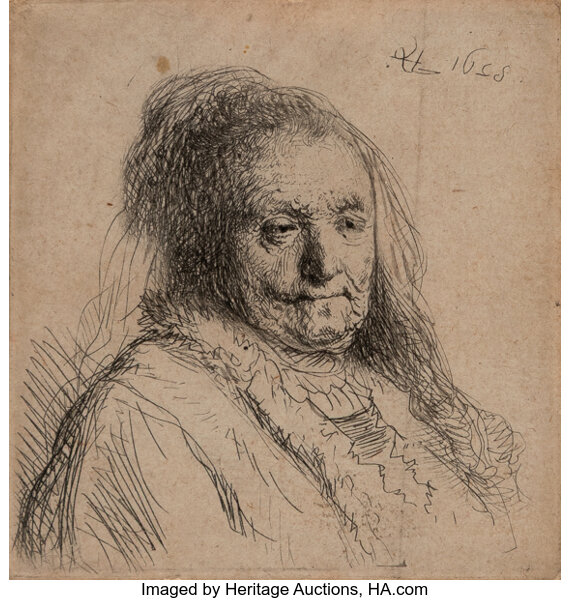 Rembrandt van Rijn
 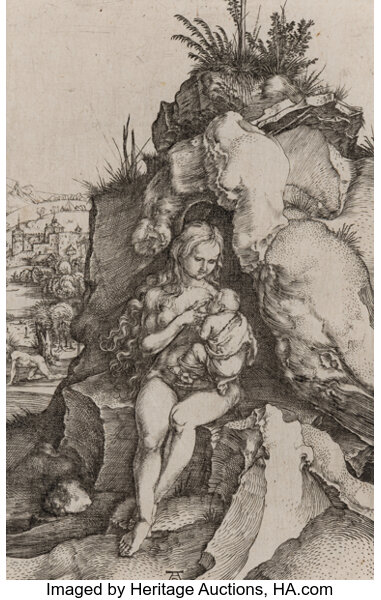 Albrecht Dürer
 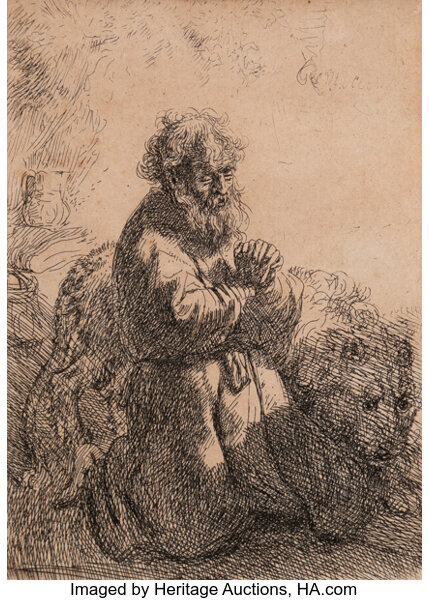 Rembrandt van Rijn